
Myofascial Release & Hip Pain
Hip Pain: Why Stretching and Foam Rolling Aren't Fixing Your Hips
You have been stretching your hip flexors. Foam rolling your IT band. Doing pigeon pose every night. And your hips still ache when you get out of a chair, stiffen up after a walk, and scream at you on the first few steps every morning. Here is why — and what actually works.
The Pattern
The Stretching Trap That Keeps Your Hips Stuck
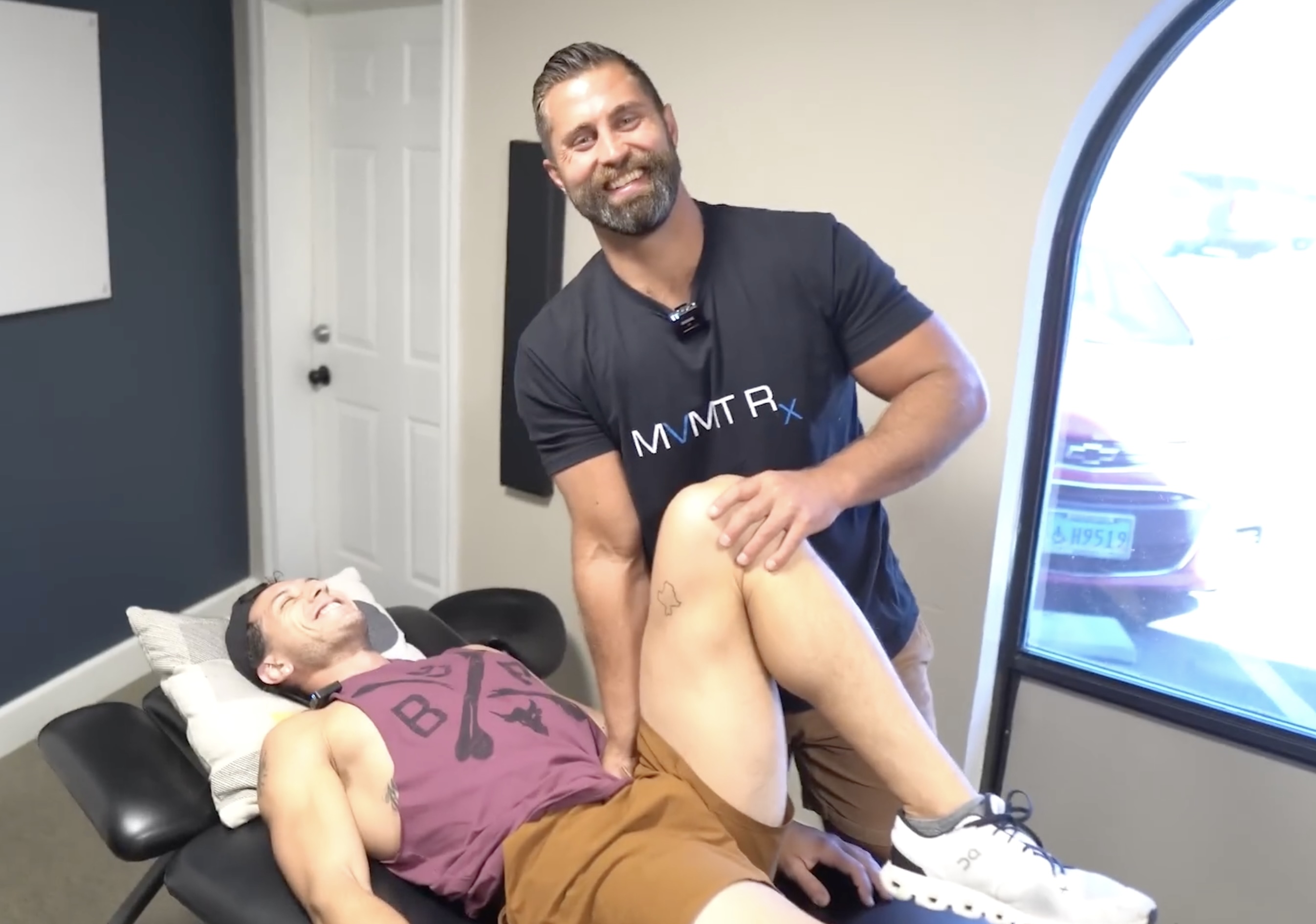
It usually starts with stiffness. Getting out of the car after a long drive. Standing up from your desk after an hour. The first few steps after sitting — that deep, grabbing sensation in the front of the hip or deep in the groin that loosens up once you get moving. You assume it is tightness. So you stretch. You foam roll. You watch a YouTube video about hip flexor stretches and do them every night before bed.
Weeks go by. Months go by. The stiffness is still there. Maybe the stretching gives you 20 minutes of relief — a temporary window where things feel a bit looser — and then it tightens right back up. So you stretch harder. You buy a lacrosse ball. You start doing pigeon pose so aggressively that your knee hurts afterward. And nothing changes. The hip is exactly where it was — or worse.
Here is what nobody told you: what you are feeling is almost certainly not tightness. It is a stability problem disguised as a mobility problem.
When the muscles around the hip — the deep rotators, the glute medius, the hip flexor complex — are weak, inhibited, or poorly coordinated, the nervous system responds by increasing tone. It creates a sensation of tightness as a protective mechanism to guard a joint that does not feel stable. Stretching that "tightness" does not fix the underlying instability. It temporarily overrides the guard — and the moment you stand up and load the hip again, the nervous system puts the guard right back. Because the problem was never flexibility. It was capacity.
If you are in Reno or Sparks and you have been stretching, foam rolling, and doing mobility work for your hips for months without lasting change, the approach is not working — and doing more of it will not produce a different result. What your hip needs is not more length. It needs more strength, better motor control, and a system that can stabilize under real-world demands.
Common experiences patients describe before finding MVMT Rx: a deep ache or grabbing sensation in the front of the hip or groin when standing from sitting, stiffness that loosens up with movement but returns after any period of rest, pain with stairs — especially going up — that feels deep in the hip joint, failed hip flexor stretching programs that never produced lasting change, foam rolling the IT band and piriformis that provides temporary relief but no resolution, being told you have "tight hip flexors" without anyone testing your hip strength, hip pain that limits hiking, squatting, lunging, or getting on and off the floor, and the growing sense that your body is getting older faster than it should.
What the Evidence Says
Why Stretching Fails — And What the Research Points To Instead
The assumption behind most hip pain treatment is that the hip is tight, and if you stretch it enough, it will loosen up and the pain will go away. The research does not support this. A 2012 systematic review in the British Journal of Sports Medicine found that static stretching alone does not reduce injury risk, does not improve performance, and does not address the neuromuscular deficits that drive most chronic musculoskeletal pain.[1] Stretching may temporarily increase range of motion through neurological tolerance — your nervous system briefly allows more motion — but it does not change the tissue, does not build strength, and does not address why the hip felt tight in the first place.
Foam rolling follows a similar pattern. A 2015 meta-analysis in the International Journal of Sports Physical Therapy found that self-myofascial release with a foam roller can produce short-term improvements in range of motion, but these effects are temporary and do not translate to meaningful functional improvements or pain reduction when used in isolation.[2] The foam roller is not changing tissue structure. It is creating a temporary neurological window — a brief reduction in tone — that closes the moment you load the joint again. This is the same pattern as stretching: a short-term override with no lasting structural or neuromuscular change.
Contrast that with clinical myofascial release performed by a trained provider. When a skilled clinician applies sustained, targeted pressure to specific fascial restrictions — the deep hip rotators, the hip flexor complex, the tensor fasciae latae, the adductor group — the treatment addresses adhesions, trigger points, and fascial restrictions that self-treatment cannot reach. The research supports targeted manual therapy as part of a multi-modal approach for hip pain: a 2014 clinical practice guideline from the Journal of Orthopaedic & Sports Physical Therapy recommends manual therapy combined with exercise for hip-related pain and mobility deficits.[3] The key word is "combined." Manual therapy creates the window. Progressive loading builds something inside it. One without the other is incomplete.
The second piece most patients never hear: imaging findings often do not tell the story you think they do. Hip labral tears are present in 69% of asymptomatic individuals with no hip pain.[4] Mild-to-moderate osteoarthritic changes on imaging do not predict how much pain you will have or how much function you can regain. If you have been told you have a labral tear, hip impingement, or early arthritis and been given the impression that your hip is damaged beyond repair, the evidence says otherwise. What imaging shows and what you are capable of are two very different things — and the gap between them is where capacity-based rehabilitation lives.
The third critical factor: hip pain in active adults is frequently driven by weakness, not pathology. A 2019 systematic review found that hip abductor and external rotator weakness is consistently associated with a range of lower extremity conditions — including hip pain, knee pain, IT band syndrome, and patellofemoral pain.[5] The glute medius and deep external rotators are the primary stabilizers of the pelvis during single-leg stance. When they are weak or inhibited, the hip compensates with increased muscular guarding (the "tightness" you feel), altered movement patterns, and joint loading that accelerates wear. Strengthening these muscles — not stretching them — is the intervention that changes outcomes.
Why the standard approach fails for chronic hip pain: static stretching temporarily overrides protective tone without addressing the underlying instability, foam rolling creates short-lived neurological relief without structural or functional change, self-myofascial release cannot reach the deep hip rotators and fascial restrictions driving most hip pain, imaging findings like labral tears and mild arthritis are present in a large percentage of pain-free people, most hip pain programs never assess or address glute medius and deep rotator weakness, hip flexor stretching can actually increase irritation in hips that are guarding due to instability, and no amount of mobility work will produce lasting change if the hip cannot stabilize under load.
Looking Deeper
Your Hip Pain Is Rarely Just a Hip Problem
The hip joint sits at the intersection of the entire kinetic chain. It is influenced by what happens above it — the trunk, the pelvis, the lumbar spine — and what happens below it — the knee, the ankle, the foot. When we see chronic hip pain that has not responded to stretching, foam rolling, or even physical therapy, the drivers are almost always somewhere beyond the hip joint itself.
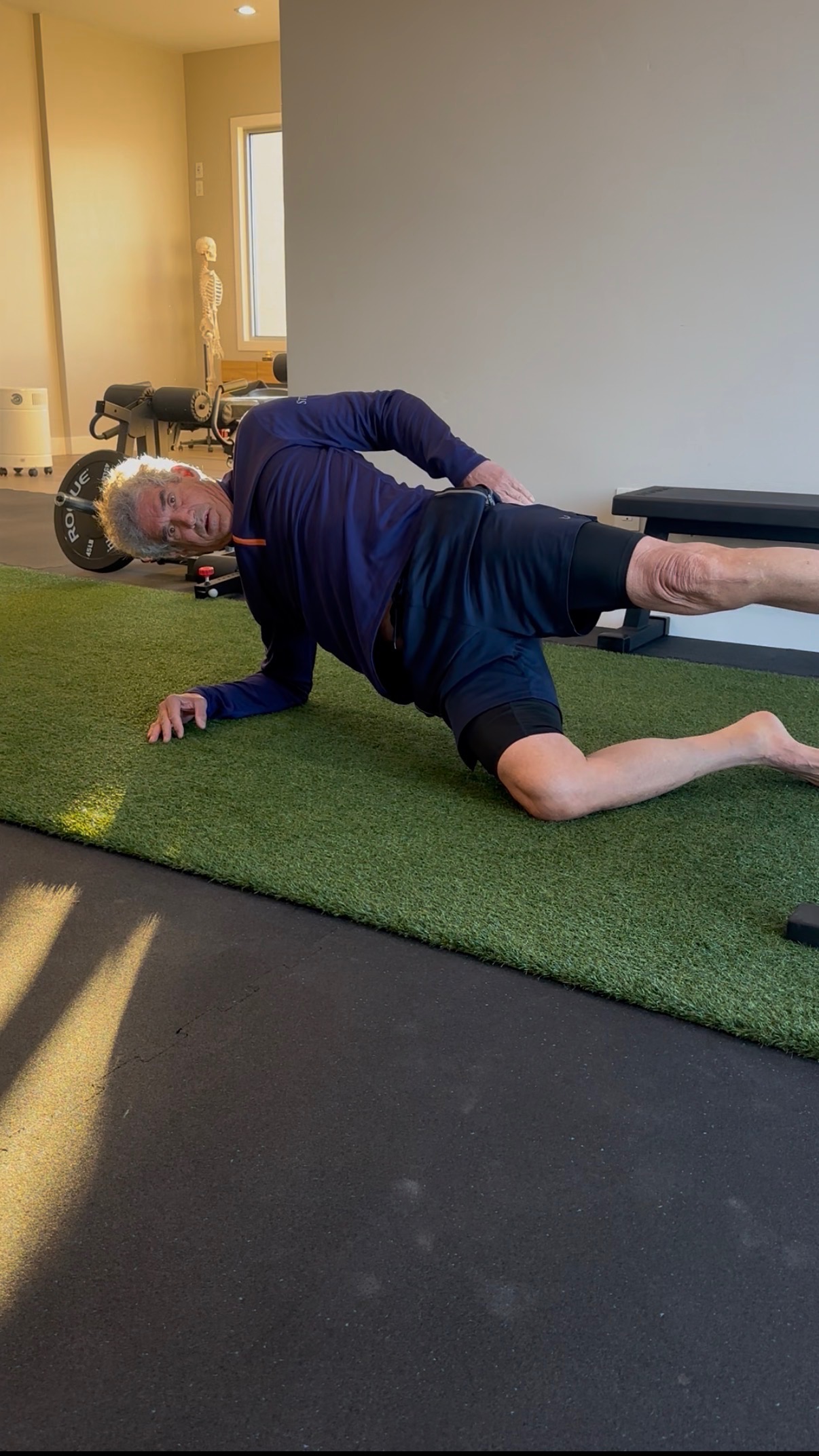
The most common driver we see is glute medius and deep hip rotator weakness. The glute medius is the primary stabilizer of the pelvis during walking, stair climbing, and any single-leg activity — which is what most of human movement actually is. When the glute medius is weak or inhibited, the pelvis drops on the opposite side during stance phase, the hip adductors and TFL overwork to compensate, and the hip joint absorbs forces it was never designed to handle in that direction. The deep external rotators — piriformis, obturator, gemelli, quadratus femoris — work as fine-tuning stabilizers that keep the femoral head centered in the socket. When they are weak, the hip loses its centration, and the nervous system responds with protective tone that feels exactly like tightness. Stretching the piriformis when it is guarding a poorly centrated hip is like cutting a rope that is holding a bridge together. The temporary slack feels better — until the whole system has to load again.
The second driver is lumbopelvic control and trunk stability. Through our training in Dynamic Neuromuscular Stabilization (DNS), we assess how well the trunk creates intra-abdominal pressure, how the ribcage orients relative to the pelvis, and how the diaphragm functions as a stabilizer — not just a breathing muscle. When the core cannot stabilize the pelvis and lumbar spine properly, the hip muscles are forced to do double duty: stabilize the pelvis from below while also moving the leg. They cannot do both well, and the result is chronic overwork, guarding, and pain that presents as "tight hips." DNS restores the proper relationship between the trunk and the pelvis so the hip can do its actual job — move — without also having to be the foundation.
The third driver — and one that is almost never assessed in hip pain patients — is neural involvement. The femoral nerve, the obturator nerve, and the lateral femoral cutaneous nerve all pass through or near the hip region. When these nerves become sensitized, restricted in their ability to slide through surrounding tissue, or compressed by fascial adhesions and muscular hypertonia, they can produce deep hip pain, groin pain, anterior thigh pain, and sensations of stiffness or catching that mimic joint pathology. Through clinical neurodynamics — the assessment of how nerves move, tension, and slide through the body — we can identify whether neural involvement is contributing to your hip symptoms. If it is, stretching and foam rolling are not just ineffective — they can actively irritate the nerve and make the problem worse.
The fourth consideration is fascial restrictions and soft tissue quality. The hip is surrounded by some of the thickest, most layered fascial structures in the body — the iliotibial band, the thoracolumbar fascia, the deep fascia of the hip rotators, and the fascial connections between the adductors and the pelvic floor. When these fascial layers become restricted — through prolonged sitting, deconditioning, prior injury, or chronic compensatory patterns — they limit the hip's ability to move through its full range and can create localized pain that no amount of self-rolling will resolve. This is where clinical myofascial release becomes critical: a trained provider can access and treat restrictions in the deep hip rotators, the psoas and iliacus complex, the adductor compartment, and the TFL/IT band junction in ways that a foam roller physically cannot reach. The treatment must be skilled, targeted, and combined with progressive loading to maintain the gains.
The fifth piece is lumbar spine involvement. Hip pain — particularly pain in the groin, the front of the thigh, or the lateral hip — is one of the most common referral patterns from the lumbar spine. Disc issues or facet joint dysfunction at L2, L3, or L4 can refer pain directly into the hip and groin. We see patients constantly who have been treated for hip impingement, hip bursitis, or labral tears when the actual source of their pain is a lumbar segment that was never assessed. Until someone performs a thorough lumbar provocation assessment and checks for directional preference using McKenzie-based (MDT) assessment, this driver goes unidentified — and the hip treatments keep failing because they are treating the wrong structure.
Root causes we commonly find driving chronic hip pain: glute medius and deep hip rotator weakness creating protective guarding disguised as tightness, poor hip joint centration from inhibited stabilizers, lumbopelvic control deficits forcing the hip muscles to compensate for a weak core, femoral or obturator nerve sensitization mimicking joint-based hip pain, deep fascial restrictions in the hip rotators and psoas that self-treatment cannot reach, lumbar spine referral patterns misdiagnosed as hip impingement or bursitis, IT band overload driven by hip abductor weakness rather than IT band tightness itself, loss of hip internal rotation from capsular restrictions or motor control deficits, deconditioning from prolonged sitting and activity avoidance, and movement pattern dysfunction — squatting, lunging, and stair climbing with compensatory strategies that overload the hip joint.
We use objective measurements — dynamometer testing for hip abductor and rotator strength, range of motion assessment in all planes, manual palpation of every structure around the hip joint, limb symmetry comparison, and functional movement analysis under load — to quantify exactly where the deficits are. We calculate side-to-side symmetry and compare your results to normative data derived from hundreds of thousands of pain-free active adults, using torque values that account for your body weight and limb length. That data drives the plan. Not a protocol. Not a guess. Not an X-ray.
A Different Approach
How We Fix Hip Pain That Nothing Else Has Fixed
At MVMT Rx, we use a clinical reasoning framework called the RAIL System that guides every decision we make — from your first visit through long-term resolution. For hip pain, this framework is what separates a care plan that keeps you stretching indefinitely from one that actually rebuilds the hip's capacity and gets you back to the activities that matter.
Relief — The first priority is calming the hip down and creating a mechanical environment where loading can begin. Clinical myofascial release targets the deep hip rotators, the psoas and iliacus complex, the TFL, and the adductor group — fascial restrictions that a foam roller cannot access and that are driving protective guarding around the joint. Chiropractic adjustments restore segmental mobility to the hip, the sacroiliac joint, and the lumbar spine. Class IV laser therapy reduces inflammation at the tissue level. McKenzie-based assessment identifies whether directional loading can centralize symptoms originating from the lumbar spine. And neurodynamic assessment determines whether femoral or obturator nerve involvement is contributing to your symptoms. Relief matters — but it is the starting line, not the finish.
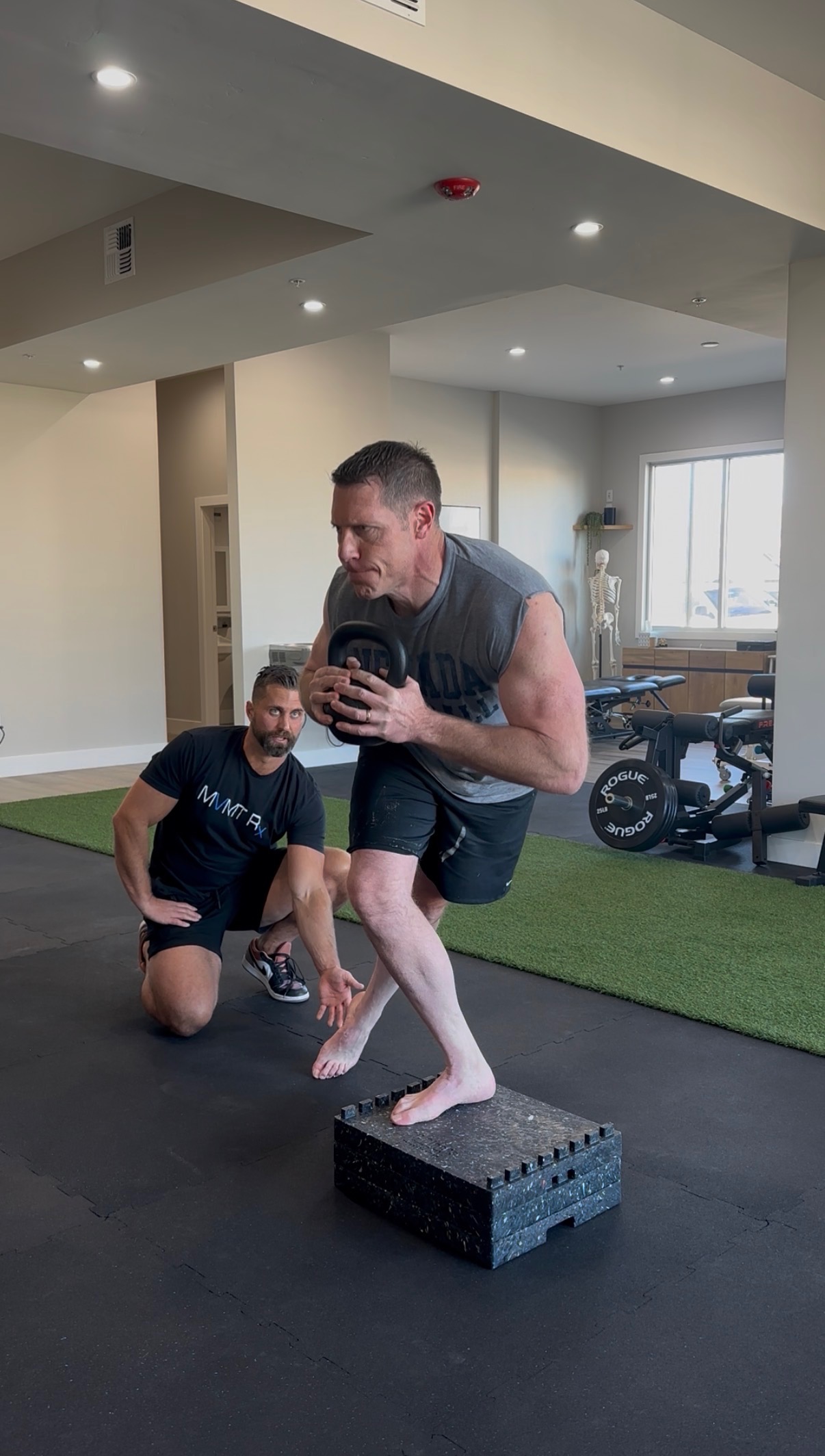
Adaptation — Once the acute irritation is managed and fascial restrictions are addressed, we begin building the capacity that was missing. Hip abductor and external rotator strengthening — progressively loaded, objectively measured with dynamometry, and dosed based on your specific deficits. DNS-based training to restore proper trunk stability and hip centration — so the hip can move without also having to be the foundation. Progressive single-leg loading to build the real-world stability your hip needs for walking, stairs, hiking, and getting on and off the floor. Every exercise is dosed based on objective testing and progressed based on measurable improvement — not time or guesswork.
Integration — This is where we start challenging the hip with complex, multi-joint, real-world movements — squatting, lunging, step-ups, lateral movements, loaded carries, and sport-specific demands. We reintroduce the activities your hip needs to handle in daily life — hiking for hours without stiffening up, playing pickleball without the groin grabbing, traveling without dreading the car ride, and getting off the floor with your grandkids without needing to think about it. By the end of this phase, we are not just managing your hip. We are building a lower body that supports it.
Lifespan — You graduate with the strength, the capacity, and the skillset to manage your hip long-term. You understand what your hip needs to stay healthy, you know how to train it, and you have the confidence to push yourself without fear of the stiffness and pain returning — whether you are hiking in Tahoe, traveling internationally, training hard, or just living your life without constantly thinking about your hip.
Stretching is not a plan. Foam rolling is not a plan. Building capacity is the plan.
What This Looks Like
What a Hip Pain Plan Actually Looks Like at MVMT Rx
Every patient is different, but here is the general shape of how we approach persistent hip pain — the kind that has not responded to stretching, foam rolling, or the "just open up your hip flexors" advice you have been following for too long.
Step 1 — Free Discovery Call: A phone call where we learn about your situation — how long you have been dealing with hip pain, what you have tried, what has failed, and what activities you are missing. We answer your questions, explain how our approach is different, and determine whether it makes sense to meet in person. No commitment. No pressure. Just a real conversation to see if we are the right fit.
Step 2 — Free Discovery Visit: A 60-minute, in-person assessment where we walk through your full history — including every provider you have seen, every treatment you have tried, and every activity you have modified or given up because of your hip. We perform a functional evaluation of the entire hip and lower extremity chain — not just the stiff spots — and give you a clear picture of what is actually driving your pain. We assess hip strength in all planes, range of motion, deep rotator function, lumbar spine involvement, nerve mobility, and how your body moves under load. This is a root cause assessment, not a sales pitch. The goal is mutual confidence that you are in the right place and we can help.
Step 3 — Evaluation and First Treatment: If we both agree it is the right fit, we complete the clinical picture with additional assessment, then turn everything into a structured treatment session so you can experience firsthand what a high-intention, 60-minute session looks like — clinical myofascial release, chiropractic adjustments, targeted loading, and clinical coaching in the same visit. From there, we make a clinical recommendation on a plan of care — including time, frequency, and investment — decided together.
Ongoing Care: Every session is 60 minutes, one-on-one with your doctor. Your plan adapts weekly based on how your hip responds. Myofascial release is used strategically to maintain tissue quality and address restrictions as they surface — not as a standalone fix — and paired with progressive rehabilitation that builds real capacity between visits. You receive programming to follow at home, at the gym, or on the road. You are coached, progressed, and held accountable through every phase of recovery. And you develop the movement literacy and body awareness to confidently manage your own hip for life — not depend on someone else to keep it feeling decent.
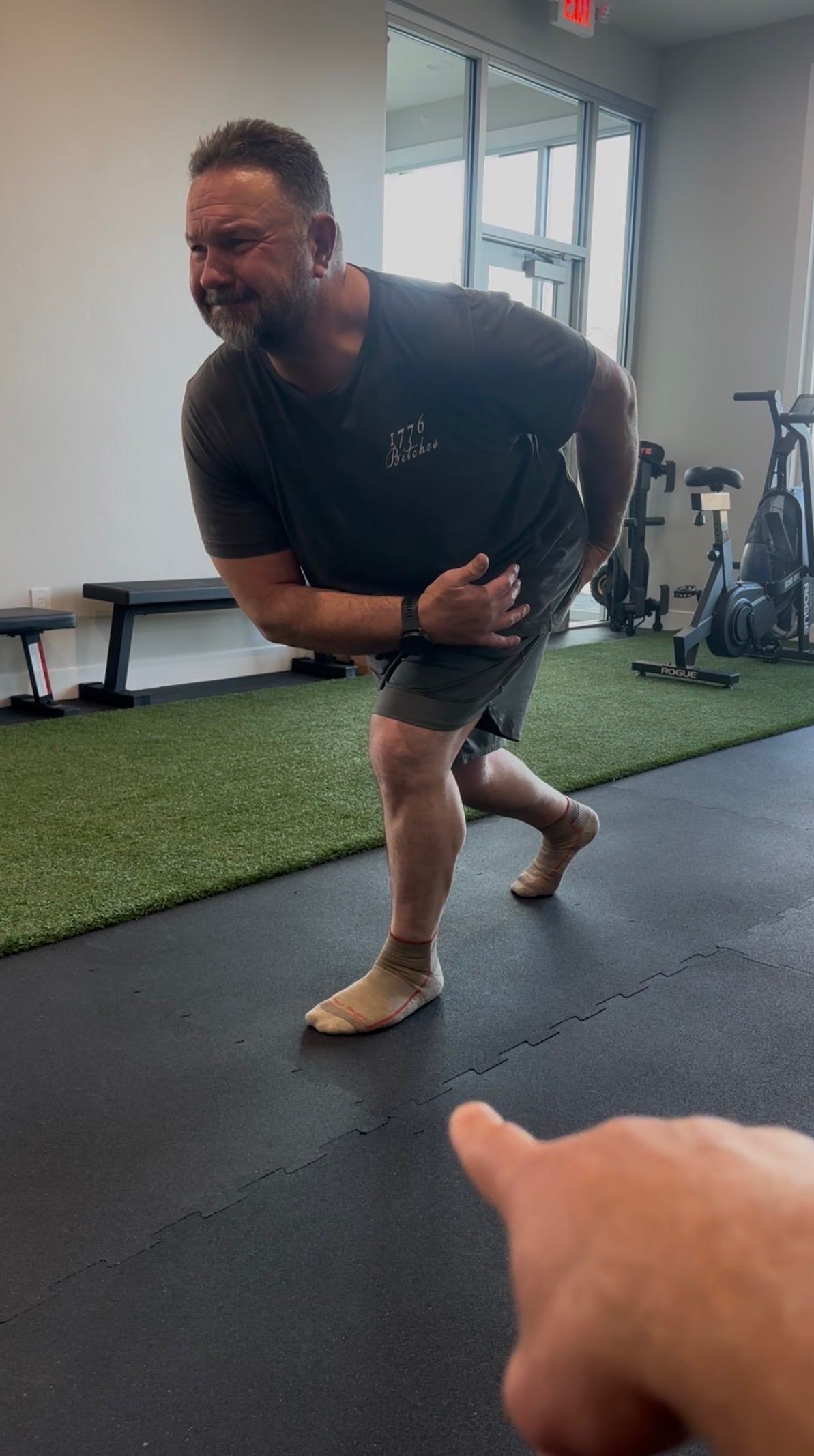
What a hip pain plan at MVMT Rx may include: clinical myofascial release targeting deep hip rotators, psoas, iliacus, TFL, and adductors, chiropractic adjustments to the hip joint, SI joint, and lumbar spine, Class IV laser therapy for tissue-level pain and inflammation reduction, McKenzie-based assessment and directional loading for lumbar-referred hip pain, clinical neurodynamic techniques for femoral and obturator nerve involvement, DNS-based hip centration and lumbopelvic stability training, progressive hip abductor and external rotator strengthening, single-leg balance and proprioceptive training, functional movement retraining for squatting, lunging, and stair climbing, dynamometry-based objective retesting to track measurable progress, and ongoing plan adaptation based on your response.
Learn More: Clinical Myofascial Release at MVMT Rx →
How we use targeted, provider-delivered myofascial release — not foam rolling — as part of the RAIL System for hip pain in Reno and Sparks, NV.
Read the Full Guide: Why a Multi-Modal Approach Works →
Our complete breakdown of the RAIL System, our clinical toolkit, and why single-modality care fails for chronic pain.
Related: Lateral Hip Pain in Women 40–60+ — Why Piriformis Stretches and Cortisone Aren't Fixing It →
Pain on the outside of the hip that flares with side-sleeping and stairs is usually gluteal tendinopathy — not bursitis, and not your piriformis. Two self-tests and what actually resolves it.
Related: Do Tight Hips Cause Low Back Pain? →
The honest answer on hip mobility and back pain — what the research actually shows, and why building hip capacity beats chasing a stretch.
Related: Why Your Low Back Pain Keeps Coming Back After Every Adjustment →
The same adjustment-plus-rehab approach applied to chronic low back pain — DNS, McKenzie, and progressive loading.
Related: Knee Osteoarthritis — Why Generic Exercise Programs Fail →
Why your X-ray does not define your ceiling, and how objective testing and progressive loading change the outcome for knee OA.
Related: Why Your Shoulder Isn't Getting Better →
Rotator cuff tears, impingement, and frozen shoulder — why passive care fails and what objective-driven rehabilitation actually looks like.
Related: Neck Pain After Failed Chiropractic Care →
Why adjustments alone do not resolve chronic neck pain, and how McKenzie assessment, clinical neurodynamics, and progressive rehabilitation change the outcome.
Related: Achilles Tendinopathy — Why Rest and Stretching Are Making It Worse →
Focused shockwave therapy, progressive loading, and midfoot mobility — why rest and cortisone fail for chronic Achilles tendon pain.
Related: Why Your Plantar Fasciitis Won't Go Away (And What Actually Works) →
Focused shockwave therapy, progressive loading, and clinical neurodynamics — why the stretch-ice-rest cycle fails for chronic heel pain.
Related: Herniated Disc — What Your MRI Isn't Telling You →
Class IV laser therapy, McKenzie assessment, neurodynamics, and progressive loading — why rest and fear make disc herniations worse.
Frequently Asked Questions
Hip Pain Questions We Hear Every Week
Why does my hip feel tight even though I stretch every day?
Because what you are feeling is almost certainly not tightness — it is protective tone. When the muscles around the hip are weak or inhibited, the nervous system increases muscular tension to guard the joint. Stretching temporarily overrides that guard, but the moment you load the hip again, the tone returns. The solution is not more stretching — it is building the strength and stability that allows the nervous system to release the guard permanently.
My doctor told me I have a labral tear. Does that mean I need surgery?
Not necessarily. Hip labral tears are present in 69% of people with absolutely no hip pain. The presence of a labral tear on imaging does not mean it is the source of your symptoms. Many labral tears are incidental findings — age-related changes that coexist with the actual driver, which is often a strength or motor control deficit. Our evaluation determines whether your labral tear is clinically relevant or whether the real problem is somewhere else entirely. Most patients with labral tears improve significantly with targeted rehabilitation.
Is foam rolling bad for my hips?
Foam rolling is not bad — but it is not a solution. It can create a temporary window of reduced tone and improved range of motion, which can be useful as a warm-up or a short-term tool. The problem is when foam rolling becomes the primary strategy for managing hip pain. It does not change tissue structure, does not build strength, and cannot access the deep hip rotators and fascial restrictions that are driving most chronic hip pain. Clinical myofascial release performed by a trained provider reaches structures that self-treatment physically cannot.
Can hip pain come from my lower back?
Yes — and this is one of the most commonly missed diagnoses we see. Disc issues or facet joint dysfunction at L2, L3, or L4 in the lumbar spine can refer pain directly into the hip, groin, and front of the thigh. Patients are often treated for hip impingement, hip bursitis, or labral tears when the actual source is a lumbar segment that was never assessed. Our evaluation includes lumbar provocation testing and McKenzie-based directional loading to determine whether the lumbar spine is the actual driver of your hip symptoms.
I have hip pain with squatting and going up stairs. Is that normal?
It is common, but it is not normal — and it is not something you should accept as part of aging. Pain with squatting and stair climbing usually indicates a strength or motor control deficit in the hip stabilizers — the glute medius, deep external rotators, and the muscles that control hip centration under load. These deficits are testable, measurable, and trainable. Our evaluation identifies exactly where the breakdown is occurring and builds a plan to restore pain-free function in these movements.
I have been told I have hip impingement. Can that be treated without surgery?
In most cases, yes. Femoroacetabular impingement (FAI) is a structural finding on imaging that describes how the bones of the hip are shaped. But the presence of impingement morphology does not automatically mean surgery is required. Research shows that many people with FAI-type bone shapes on imaging have no pain at all. The pain is often driven by how the hip loads, how the surrounding muscles control movement, and whether the hip can centrate properly under demand. Targeted rehabilitation that addresses these factors — motor control, hip stability, loading capacity — can produce significant improvement in pain and function without surgery.
What is the difference between clinical myofascial release and foam rolling?
Depth, precision, and expertise. A foam roller applies broad, superficial pressure across the surface of a muscle group. Clinical myofascial release performed by a trained provider applies sustained, targeted pressure to specific fascial layers, adhesions, and trigger points — including deep structures like the psoas, iliacus, deep hip rotators, and adductor compartment that a foam roller physically cannot reach. The clinical treatment is guided by palpation, clinical reasoning, and knowledge of the specific restrictions driving your symptoms. Foam rolling is a blunt tool. Clinical myofascial release is a precision intervention.
What is different about MVMT Rx compared to the PT or chiropractor I have already seen?
Three things. First, every session is 60 minutes, one-on-one with your doctor — you are never handed off to an aide or technician. Second, we combine clinical myofascial release, chiropractic adjustments, progressive rehabilitation, McKenzie-based assessment, clinical neurodynamics, and DNS under one roof — in the same session. Third, we use objective testing — dynamometry, range of motion, side-to-side comparison — and a clinical reasoning model called the RAIL System to guide every decision — not generic protocols, not arbitrary visit counts, and not insurance authorization timelines.
Conditions and symptoms we treat at MVMT Rx related to hip pain: chronic hip pain, hip stiffness and reduced range of motion, hip pain with squatting and stair climbing, hip pain when standing from sitting, hip flexor tightness and pain, hip impingement (femoroacetabular impingement / FAI), hip labral tear conservative treatment, hip bursitis and trochanteric pain syndrome, hip pain treatment and rehabilitation in Reno and Sparks NV, clinical myofascial release for hip pain, deep hip rotator weakness and inhibition, glute medius weakness and hip instability, piriformis syndrome and deep hip rotator dysfunction, IT band pain and lateral hip pain, groin pain and adductor strain, hip pain referred from the lumbar spine, femoral nerve and obturator nerve involvement in hip pain, clinical neurodynamics for hip and groin symptoms, DNS hip centration and lumbopelvic stability training, McKenzie assessment for lumbar-referred hip pain, hip pain after failed physical therapy, hip pain after failed chiropractic care, hip pain from prolonged sitting and desk work, hip osteoarthritis conservative treatment Reno, hip pain limiting hiking walking and travel, sports chiropractor hip pain Reno NV, performance rehab for hip pain active adults Sparks, MVMT Rx Sports Care and Chiropractic hip specialist Reno NV, and cash pay hip pain treatment Reno Sparks Nevada.
References
- Lauersen JB, Bertelsen DM, Andersen LB. The effectiveness of exercise interventions to prevent sports injuries: a systematic review and meta-analysis of randomised controlled trials. British Journal of Sports Medicine. 2014;48(11):871–877. doi:10.1136/bjsports-2013-092538
- Cheatham SW, Kolber MJ, Cain M, Lee M. The effects of self-myofascial release using a foam roll or roller massager on joint range of motion, muscle recovery, and performance: a systematic review. International Journal of Sports Physical Therapy. 2015;10(6):827–838. PMID: 26618062
- Enseki K, Harris-Hayes M, White DM, et al. Nonarthritic hip joint pain: clinical practice guidelines. Journal of Orthopaedic & Sports Physical Therapy. 2014;44(6):A1–A32. doi:10.2519/jospt.2014.0302
- Register B, Pennock AT, Ho CP, Strickland CD, Lawand A, Philippon MJ. Prevalence of abnormal hip findings in asymptomatic participants: a prospective, blinded study. American Journal of Sports Medicine. 2012;40(12):2720–2724. doi:10.1177/0363546512462124
- Reiman MP, Bolgla LA, Loudon JK. A literature review of studies evaluating gluteus maximus and gluteus medius activation during rehabilitation exercises. Physiotherapy Theory and Practice. 2012;28(4):257–268. doi:10.3109/09593985.2011.604981
Done Stretching a Hip That Needs to Be Strengthened?
If stretching, foam rolling, and mobility work have not fixed your hip — the problem is not your flexibility. It is the approach. Start with a free conversation.
Book Your Free Discovery CallMVMT Rx Sports Care & Chiropractic | Reno & Sparks, NV | (775) 245-4142


Free Guides
Patient Care
Links
© Copyright 2026. MVMT Rx Sports Care & Chiropractic. All Rights Reserved.